Showing posts with label Egun. Show all posts

The One Man Band / L'Homme Orchestre: DANIALOU SAGBOHAN (Full movie / 2006)


After several years of sleep, I decided to share and give life again to this beautiful portrait. A documentary which I signed images, editing and directing. From 200 to 2007, I followed Danialou Sagbohan throughout Benin. An immersion with one of the famous singer and musician of african continent.
I also dedicate this film to Djibril Sagbohan, the eldest son of Danialou, who participated to the movie, who assisted me ad who tragically died december 12, 2013, during the birthday party of his father.


Après plusieurs années de sommeil, j'ai décidé de redonner vie à ce magnifique portrait sur la toile. Un film dont j'ai signé les images, le montage et la réalisation. De 2000 à 2007, j'ai suivi Danialou Sagbohan dans tout le Bénin. Une immersion avec l'un des plus grand chanteur et musicien africain. 
Je dédicace aussi ce film à Djibril Sagbohan, le fils ainé de Danialou, qui a participé au film, qui m'a assisté et qui est mort tragiquement le 12 décembre 2013, durant la fête anniversaire de son père.


Egungun of Ouidah / Les Revenants de Ouidah (1976)


I know many of you like sacred music recordings such as Egungun masks. This record includes several songs from Egungun's repertory recorded by Djomakon band of Ouidah and his lead singer Adedjobi.

"Only the spirits that are specially prepared to be invoked and to materialize can receive the name of Egungun, Baba Egun. The main objective of the cult is to make visible the spirits of the ancestors which act as a link between the living and their forefathers. Thus, the Baba bring to their descenders and believers, their blessings and advice but can not be touched. The Egun must always remain seperated from the living."


Je sais que beaucoup d'entre vous appréciez les enregistrements de musique sacrée comme celle des masques Egungun. Ce disque regroupe plusieurs titres du répertoire des Egungun enregistrés par le groupe Djomakon de Ouidah et son chanteur Abédjobi.

"Seuls les esprits les esprits initiés à l'invocation et la matérialisation peuvent prendre le titre d'Egungun. L'objectif principal du culte est de rendre visibles les esprits des ancêtres qui agissent comme un lien entre les vivants et les morts. Ainsi, l'Egun apporte aux descendants et croyants, des bénédictions, des conseils mais il ne doit pas être touché. L'Egun doit toujours resté séparé des vivants.


Dossou Letriki (ALS 139)


I found a dozen of rare records on Albarika Store label, all traditional music recordings. I Propose to explore them chronologically but in reverse order. I also suggest you to discover all the different rhythms that have populated the kingdoms of Benin's music.
We start with the number 139, recorded in 1984 and which rhythm is called "Egoun" (See illustration and for those who have forgotten the Egun's story, see these pages). The author and orchestra's leader, Migbogohin Assogba Dossou aka Dossou Letriki, has the status of Yedenou Adjahoui's student. He plays a fetish rhythm from the people of Port-Novo, the "Masse-Gohoun". Adjahoui was the king of this rhythm and when the king died in 1995, Letriki became the reference. In march 2010, the student joined the master. He leaves behind children and women, and about thirty albums. Letriki is coming back today with this nice quality sound recording and melodies haunted by the spirits of Egun.


J'ai trouvé une série de disque rares sur le label Albarika Store, tous des enregistrements de musique traditionnelle. Je propose de les découvrir chronologiquement mais en commençant par la fin. Je suggère aussi de découvrir tous les differents rythmes qui ont peuplé les royaumes musicaux du Bénin.
On commençe donc avec le numéro 139, enregistré en 1984 et dont le rythme est celui des "Egoun", ou revenants (voir l'illustration et pour ceux qui ont oublié l'histoire des "Egoun", conlustez ces pages). L'auteur et chef d'orcestre est Migbogohin Assogba Dossou alias Dossou Letriki. Il était un élève de Yedenou Adjahoui, le roi du rythme "Masse-Gohoun", un ryhtme fétiche pour les habitants de Porto-Novo, la capitale. Depuis la mort du roi en 1995, Dossou Letriki est devenu une référence. En Mars de cette année, l'élève a rejoint le maître. Dossou Letriki, laisse derrière lui des enfants, des femmes et une trentaine d'oeuvres phonographiques. Letriki nous revient aujourd'hui avec cet album d'une bonne qualité d'enregistrement et dont les mélodies nous rappelles aux esprits des "Egoun".

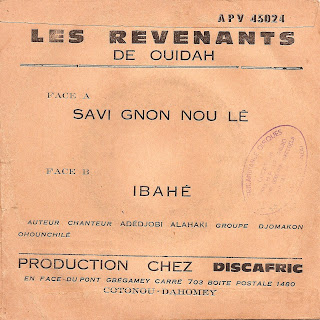
Les Revenants de Ouidah


1965, still on Discafric Label, here are the "Revenants de Ouidah". The "Revenants" are ghosts. They are called Egungun in Yoruba language and Kuvito in Fon language. They represent spirits of the dead who come back, hidden from head to foot, to communicate, in words and music, judgments or councils to the living people. The Egungun belong to secret societies and not to a Voodoo god. Becareful, Touching a Egungun can cause your death !

oro

Toujours sur le label Discafric, voici "les Revenants de Ouidah". Les revenants sont appelés Egungun en langue Yoruba et Kouvito en langue Fon. Ils représentent les esprits des morts, qui reviennent masqués des pieds à la tête, afin de prodiguer des conseilset des jugements aux vivants. Les Egungun appartient à des sociétés secrètes et non à un dieu Vodoun. Attention, toucher un revenant peut causer votre mort !

Les Sympathics (1978)


Orchestra Les Sympathics was created in 1972 by Herman Layele, the leader of the famous Black Dragons ' orchestra. This Albarika's opus is wonderful and I have been looking after it for a long time. Herman is still alive and sings every sunday in Porto-Novo, Benin. He is more than a singer and a composer. He became Balé. That means that he became chief of a Vodun Society of masks called Egungun, the masks of dead people. This album was recorded in 1978 and it has something special and different from the same period.

oro

L'orchestre Les Sympathics a été fondé en 1972 par Herman Layele, le fameux leader de l'orchestre Black Dragons. Ce nouveau chapitre d'Albarika est prodigieux. Je le cherchais depuis un moment et c'est chose faite. Herman (à gauche sur la pochette) est toujours vivant et chante tous les dimanches à Porto-Novo, Bénin. Il est plus qu'un chanteur et compositeur, il est devnu Balé. Cela signifie qu'il est devenu chef de culte Vodoun, celui des revenants et de leur masques puissants: les Egungun. Cet album a été enregistré en 1978 et il a quelque chose de spécial come sa pochette.

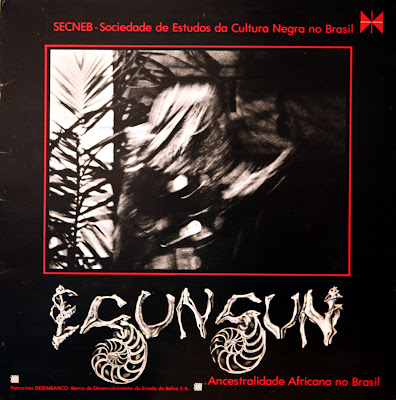
EGUNGUN (Brazil 1964)


This post is an answer of an previous post about Dahomey's Egungun music. This LP is taken from a fantastic work about Egungun ceremonies in Salvador de Bahia. Recorded in 1964, nothing changed between Benin and Brazil.

oro

"Only the spirits that are specially prepared to be invoked and to materialize can receive the name of Egungun, Baba Egun. The main objective of the cult is to make visible the spirits of the ancestors which act as a link between the living and their forefathers. Thus, the Baba bring to their descenders and believers, their blessings and advice but can not be touched. The Egun must always remain seperated from the living."

Side A:
1. Iba Orisha Iba Onile
Salutation to Onile at the beginning of every ceremony.

2. Osanyin
Three chants praising Osanyin, patron of leaves and medecine.

3. Egunugun Kigbale
Through this chant the ancestors are called to come and embody themselves in the world of the living.

4. Ewo Nile
Warning call, something is going to happen. The ancestor is going to arrive.

5. Oro Abi Oro
This chant expresses the meaning of the rit itself oro), re-enacting the comunity links, bringing happiness, goodness and welfare.

6. Onile Mo Bodo Ile
Baba is arriving, he announces himself saluting the elders and asking permission to come in.

7. Nile Wa Alagbe
Baba sings, encouraging the Alagbe, the ritual musicians.

8. Agboula Ago Nile
When Agboula comes to world, evrything rejoices in happiness

9. O She Wara Wara
Two chants in homage to Shango, divine ancestor of the royal dinasty of Oyo from where the Agboula community traces its origins. Many of the Egun revered today, were in life, Shango worshipers.

Side B:
1. Salutations to Baba Olukutun, head of all the ancestors.

2. Loni Ojo Odun
Two chants of great joy for the annual festival of Baba Olukotum. A burst of rockest intensifies the ceremony.

3. Kiye KiyeBo Iroko
Homage to the Egun of the forefathers that were in lifetime woreshipers.

4. Orisha Wa Iye
A chant calling the entities to come and dance with joy.

5. Afulele Ade
A chant in homage to Oya Igbale, queen and patroness of the Egun.

6.Omi Ro
A most profound chnat that evokes all african ancestry.

7. Aluja
The drums play the Aluja, the favourite rhythm and dance for Shango, head of kings, Alafin of Oyo, owner and patron of fire and thunder.

Dahomey (1952)


In 1952, Pierre Verger, the famous Photographer and Ethnologist, took those pictures (the sleeve too) of Egun ceremony in Benin. Egun is a mask.


A dead spirit who's coming back behind costume, music, song, dance, advices and judgments for living people. The recording is from Gilbert Rouget, the great musical ethnologist who worked during a long period in Benin.