Kabore Oger & Harmonie Voltaique (Burkina, 1975)


This is a rare single recorded in 1975 by the leading Burkinabe band, "Harmonie Voltaique", and pressed in Benin, as usual during this period. It features an excellent soukous tune with a strong local accent and a mellow ballad.

Voici un rare 45 tours enregistré en 1975 par le célèbre orchestre orchestre "Harmonie Voltaique" et pressé au Bénin, comme c'était la coutume à l'époque. Sur ce disque, un titre soukous aux accents mandingues et une ballade romantique.

Professeur Bylledey: A.V.A. Promotions N°4


Professor Bylledey Guissey is not unknown on Oro. For those who don't know, I invite you to discover this album with Poly-Rythmo where he sings modern music. Indeed, after this album, Bylledey decided to devote himself to traditional music. Bylledey was an intellectual, a professor of theatre, rooted in tradition.
This album is another special opus from label A.V.A. Promotions, a label always surprising. It was released in 1980 and it is one of the best Professor's album.


Professeur Bylledey Guissey nest pas inconnu sur Oro. Si vous ne le connaissez pas je vous invite à le découvrir sur cet album, avec Poly-Rythmo, où il chante sur une musique moderne. En effet, après cet album, Bylledey décide de se consacrer à la musique traditionnelle (ou folklorique). Bylledey était un intellectuel, professeur de théâtre, ancré dans la tradition.
Cet album est le 4ème opus du label A.V.A. Promotions, alias "Aux Vrais Aubaines"; un label toujours surprenant. Il a été enregistré en 1980 et c'est le meilleur album du Professeur.

Orchestre Harmonie Nigérienne (Niger, 1972)


My friends, Oro has no informations about orchestra "Harmonies Nigériennes", except that the band is from Niger. The composer and singer, Camille Gbehou, comes from Benin. This Djerk and Soul vinyl was recorded in 1972.

Mes amies, Oro n'a aucune informations sur l'orchestre Harmonies Nigériennes, excépté que c'est un orchestre de Niamey, Niger. Le compositeur et chanteur, Camille Gbêhou, est Béninois. Cet enregistrement Djerk et Soul date de 1972...

Les Revenants de Ouidah


1965, still on Discafric Label, here are the "Revenants de Ouidah". The "Revenants" are ghosts. They are called Egungun in Yoruba language and Kuvito in Fon language. They represent spirits of the dead who come back, hidden from head to foot, to communicate, in words and music, judgments or councils to the living people. The Egungun belong to secret societies and not to a Voodoo god. Becareful, Touching a Egungun can cause your death !

oro

Toujours sur le label Discafric, voici "les Revenants de Ouidah". Les revenants sont appelés Egungun en langue Yoruba et Kouvito en langue Fon. Ils représentent les esprits des morts, qui reviennent masqués des pieds à la tête, afin de prodiguer des conseilset des jugements aux vivants. Les Egungun appartient à des sociétés secrètes et non à un dieu Vodoun. Attention, toucher un revenant peut causer votre mort !

Super Star de Ouidah (1965)


As we already know, the Orchestre Super Star de Ouidah was one of the oldest modern band of Benin. Bentho Gustave, the bassist of the Poly-Rythmo, began his career in this formation. The two main composers and singers of the Super Star were Pascal Medagbe and Joseph Tao. They sing Bolero and Biguine songs on this EP recorded in 1965.


Comme vous le savez déjà, l'orchestre Super Star de Ouidah est un des plus anciens groupe moderne du Bénin. Bentho Gusatve, le bassiste des Poly-Rythmo, a fait ses armes dans cette formation. Les deux principaux compositeurs et chanteurs des Super Star étaient Pascal Médagbé et Joseph Tao. Ils chantent sur ce disque, enregistré en 1965, des titres d'influense Boléro et Biguine.

Orchestre C.V.D (Burkina, 1975)

The Orchestra C.V.D takes its name from the label "Club Voltaïque du Disque". This N°17 from C.V.D's label was recorded in 1975. This rare album has nice mandigo tune "Volta Mousso". The rest is average reggae and soukous influenced. Welcome to the Club...

L'orchestre C.V.D tire son nom du label "Club Voltaïque du Disque". Ce N°17 du label C.V.D a été enregistré en 1975. L'album est plutôt influensé Reggae et Soukous à part le titre "Volta Mousso" qui est une bouffée d'air mandingue. Bienvenue au Club...

T.P. Poly-Rythmo & Lohento Eskill (1973)


Lohento Eskill never composed with Poly-Rythmo Orchestra. This EP proves his talent as afro-cuban music's composer. This vinyl is rare and beautiful. This recording from 1973 was released by "Dieu Merci" label ("thank's god" label) and it this post diserves this name. Unfortunately, Eskill left us in 2006 and his melancholic voice lacks Poly-Rythmo.


Lohento Eskill n'a jamais composé avec l'orchestre Poly-Rythmo. Ces deux fantastiques titres afro-cubains prouvent son talent de compositeur. Ce disque est rare et magnifique. Il a été produit par le label "Dieu Merci" et je pense que ce courrier mérite ce titre. Malheureusement, Eskill nous a quitté en 2006 et a voix mélancolique manque à Poly-Rythmo.

A. Nica
B. Binatche

"I would also like to say that Eskill did compose several songs with Poly-Rythmo. One of his most known own composition is "Agbazamimin". But it's true that he was mainly a singer, the main vehicle of Poly's songs because of his voice and performance talents (along with Clement Melome, the main composer and the band's boss). And Indeed, he was a famous salsero, even though they have played a great number of rhythms." Lohento Ken

Le Diamono (Senegal, 1975)


This EP from Le Diamono seems to be the first recording of the band which became later the Super Diamono. I dedicate this post to Aduna's blog which is the most senegalese among all the blogs.


Ce disque du Diamono semble être le premier enregistrement du groupe, qui deviendra plus tard le Super Diamono. J'adore ce groupe et je dédie ce courrier au blog Aduna qui est le plus sénégalais de tous les blogs.

Singer Nahounou & Orchestre Black Santiago


I have no information on Singer Nahounou, except that Singer is a famous sewing machine in Africa. I know that Nahounou recorded at least three albums. This N°95 from Alabarika Store was maybe recorded in 1980. Singer sews the Soukous music with talent and cover our ears with a beautiful Black Santiago's hat.


Je n'ai aucune informations sur Singer Nahounou, à part que Singer est une fameuse machine à coudre en Afrique. Je sais que Nahounou a enregistré au moin trois albums, notamment avec les Poly-Rythmo. Ce N°95 d'Albarika Store a vraisemblablement été enregistré en 1980. Singer coud de a soukous avec talent et nous couvre les oreilles du superbe chapeau "Black Santiago".

T.P. Orchestre Poly-Rythmo: Albarika Store 030


Another great opus from Poly-Rythmo offered by DJ Balafon (Vivien). Thank you, you are our friend.

Un autre super opus de Poly-Rythmo, offert par Vivien alias DJ Balafon. Merci, tu es notre ami.

Safohene Djeni (Ghana)


The background to Safehini Djeni's music career is dated as far back as the sixties when he joined T.D. Quarcoo's Guitar Band, where he learnt to play the guitar. As variety is the spice of life, he later joined guitar bands like Akompi, Okukuseku N°1, Ahamano's and later Nyame Bekyere Band led by ace actor Seaboy J.N. Ebroni and feature prominently as lead guitarist and vocalist and also composer of their hit tune "Nyame Bekyere".

Safohene Djeni fit les gloires des grands orchestres tels que Akompi, Okukuseku N°1, Ahamano et Nyame Bekeyeke Band dans le quel évolue la grande star J.N. Ebroni. Il fit sa place comme guitariste mais aussi comme chanteur et compositeur, notamment du fameux titre "Nyame Bkyere".

Eddie Siagbo & El rego et ses Commandos (Togo)


On this very nice EP, Siagbo Dieudonne Eddie composed and song. The orchestra is that of El Rego, the famous "Commandos". Siagbo seems to be from Togo.


Sur ce super 45 tours, Siagbo Dieudonné Eddies a composé et chanté. L'orchestre est celui d'El Rego, les fameux "Commandos". Siagbo semble être du Togo.

Danialou Sagbohan: "Bio Guerra" (1987)


I have already posted this record from Sagbohan Danialou but it was in a bad shape. Here is a better version of great album released in 1987.


J'ai déjà posté ce disque de Danialou Sagbohan, mais il était en mauvais état. Voici donc une meilleure version de ce grand album sorti en 1987.

Coulibaly Tidiani & Dafra Star: 1st Opus (Burkina, 1975)


Tidiani Coulibaly was born on December 31 in 1941 at Kankalaba, "Upper Volta". He is a pioneer of modern music in his country. He became famous with Volta Jazz Orchestra during the sixties. In 1975, he founded his own orchestra, the Dafra Jazz, and recorded is first album that I offer you today with tremendous pleasure. This album is rare... Coulibaly inspired many artists and was also inpired by Amadou Ballke. He pays tribute to him on "Doro Daga".
On the next opus that I will offer you soon, released in 1978, Ballake is invited to sing by Coulibaly. Be patients...

Tidjani Coulibaly est né le 31 Décembre 1941 à Kankalaba en "Haute Volta". Il est grand pionnier de la musique moderbe dans son pays. Il devient célèbre, durant les années 60s avec l'orchestre Volta Jazz. En 1975, il crée son propre orchestre, les "Dafra Star", et enregsitre son premier album que je vous offre avec grand plaisir. Cet opus est rare... Coulibaly a inspiré beaucoup d'artistes er fût, lui-même, inspiré par Amadou Ballaké. Il lui rend d'ailleurs hommage sur le morceau "Doro Daga".
Sur le prochain opus, que je vous offrirai bientôt, sorti en 1978; Ballake est invité à chanter par Coulibaly. Soyez Patients...

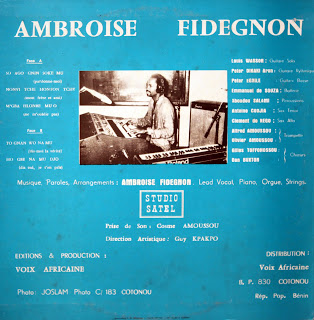
Ambroise F.


A new artist on Oro and as always: Afro-Cuban, Reggae, Funk and Pop music... Fidegnon is known to be a great pianist. Another great musician played on this record: Louis Wasson, from Cameroon, who also recorded with Sagbohan Danialou on this album. Please, my friends, enjoy "Nonvi Tche Honton Tche", a great latin tune...


Un nouvel artiste sur Oro et comme d'habitude: de l'Afro-Cubain, du Reggae, de la funk et de la Pop... Fidegnon est connu pour être un grand claviste mais, sur cet album, il y a aussi Louis Wasson, fameux guitariste du Cameroun, qui a déjà enregistré avec Sagbohan Danialou sur cet album. Vous Apprécierez, mes amis, le titre "Nonvi Tche Honton Tche" un terrible titre latin...


Cissé Abdoulaye (Burkina-Faso/1976)


Abdoulaye Cissé is called "the man with guitar" because of his talents on guitare. He has always been a teacher but his passion for music never left him. He began recording in 1974 This EP, recorded with Orchestra Harmonie Voltaique, is from 1976. Because of his lyrics, he is considered as a poet.


Abdoulaye Cissé est appelé "l'homme à la guitare" à cause de ses talents de guitariste. Instituteur de formation, sa passion pour la musique ne l'a jamais quittée. Il commence à enregistrer en 1974 et ce 45 tours date de 1976,enregistré avec l'Orchestre Harmonie Voltaïque. A cause de ses paroles, il est considéré comme un poète.

Orchestre Les Volcans & Blueky d'Almeida


"La Caravelle" (the title of the album) is a famous restaurant in Cotonou. A caravel is also a famous boat known in Africa for slaves transports. I did'nt have pictures of the restaurant so I choose a picture of a boat's relic. This album is not the best from Buecky d'Almeida or from "Les Volcans", but it has its place on Oro.


La Caravelle (le titre de l'album) est un fameux restaurant à Cotonou. La Caravelle est aussi un bateau connu en Afrique pour ses transports d'esclaves. Je n'avais pas de photos du restaurant, j'ai donc choisi la photo d'un vestige du bateau. Cet album n'est pas le meilleur de Bluecky d'Almeida ou des "Volcans", mais il a tout de même sa place sur Oro.


Bluecky d'Almeida & Poly-Rythmo


Bluecky d'Almeida is one of the odlest singer of Benin with El Rego. This recording in mono from 1973 is really interesting: "Bye Bye Vicky" is a cool Jerk rhythm, a famous rhythm and dance in France during the 60's. "Eye Miadua" is a great Highlife tune which begins with a deep Vodoun rhythm. This vinyle is quite rare, so enjoy it...


Bluecky d'Almeida fait parti des plus anciens chanteurs du Bénin avec El Rego. Cet enregistrement en mono, qui date de 1973, est particulièrement intéressant: "Bye Bye Vicky" est un excellent Jerk, rythme célèbre durant les années 60 en France, et "Eye Miadua" est titre aérien de Highlife qui débute par lourd rythme Vodoun. Ce vinyle est plutôt rare, alors bonne route...

Bella Bellow (Togo, 1969)

Here is a record by the Togolese diva Bella Bellow. It is a french pressing from 1969 released on the label "Akue". The orchestration is from a french musician, Christian Joudinaud.

Voici un disque de la diva Togolaise Bella Bellow. Ce vinyle, de 1969, est sorti sur un label français: "Akue". Enfin l'orchestration est aussi faite par un français: Christian Jourdinaud.

Stanislas Tohon: King of Tchink System (1977)


Stanislas Tohon modernized the traditional Tchinckoumé rhythm and called it "Tchink System". This album originally recorded in 1979 on Sacodis, was also released on Stan's own label. His music is powerfull, all titles emit an energy coming from Tchinckoumé rhythm but also because of Stan's exceptional musicians like his guitarist Dizi Mageco. The sound is heavy and warrior like Tohon himself.


oro

Stanislas Tohon a modernisé le rythme traditionnel Tchinkoumé et l'a renomé le "Tchink System". Cet album, enregistré initialement sur Sacodis en 1979, est sorti aussi sur le propre label de Stan. Je trouve que sa musique est vraiment puissante. Tous les morceaux dégagent une energie propre au Tchinckoumé mais aussi grâce aux musiciens exceptionnels de Stan comme son guitariste Dizi Mageco. Le son est lourd et guerrier à l'image de Tohon.

Alokpon: King of Tchinkoume Rhythm


Alokpon is the the greatest singer and the king of traditional Tchinckoume rhythm, a rhythm from the center of Benin, known for its water drums and Gotta drum which are made out of calabash. The Gotta is the biggest calabash that is commonly beaten with a shoe sole. Its sound is heavy and deep.
This 1970's recording in mono, number 11 from "Les Echos du Dahomey" is the first recording from Anatole Houndeffo called Alokpon.


Alokpon est le plus grand chanteur du rythme traditionnel Tchinckoumé, un rythme du centre du Bénin, connu pour ses tambours aquatiques et son tambour Gotta qui sont faits de calebasses. Le Gotta est la plus grande calebasse, elle est couramment frappée avec une semelle de chaussure. Son son est lourd et profond.
Ce vinyle numéro 11 de 1970, enregistré en mono par les Echos Sonores du Dahomey, est le premier enregistrement d'Anatole Houndeffo dit Alokpon.


Nestor Hountondji & Les Axes 80 (1980)


After Orchestra "Les Volcans", Nestor Hountondji recorded on his own label Nesto-Disco and with a new band: "Les Axes 80". This first solo album is rare and in very good shape.


Après "Les Volcans", Nestor Hountondji enregistre sur son propre label Nesto-Disco et avec un nouvel orchestre: "Les Axes 80". Ce premier album solo est rare et en très bonne état.

Amadou Balake & Les 5 Consuls (1974)


Dear listeners, I am sorry to share a record in a very bad Shape but I think that all the recordings from Amadou Ballake diserve to be hear...


Mes amis, je suis désolé de partager un disque de très mauvaise Qualité mais je pense que tout enregistrement d' Amadou Ballaké mérite d'être entendu...

Lolo Lolitta & Black Santiago


As you already know, I am not passionate and specialist about Congolese music. This albums interests me more because Black Santiago radiates music. And yes, many Congolese are passed by Benin and the huge Ignace de Souza, head of the Black Santiago, was the most brilliant ambassador of Soukous music in Ghana and Ivory Coast. Benin and Congo met therefore in music.
This album was recorded at Studio Satel of Cotonou in 1980. Lolo Lolitta sings with his comrade Tchico Tchicaya. Comrade, you are Congolese? So get up and dance on the sun of Benin...


Comme vous savez déjà, je ne suis pas passioné et specialiste de musique Congolaise. Cet album m'intéresse plutôt parce que l'orchestre Black Santiago fait rayonner la musique. Et Oui, beaucoup de Congolais sont passés par le Bénin et le brillant Ignace de Souza, chef du Black Santiago, était le plus brillant ambassadeur de la musique Soukous au Ghana et en Côte d'Ivoire. Le Bénin et le Congo devaient donc se rencontrer en musique.
L'album a été enregistré au Studio Satel de Cotonou en 1980. Lolo Lolitta chante avec son camarade Tchico Tchicaya. Camarade, tu es Congolais ? Alors lève-toi et danse sur le soleil Béninois...

Yedenou Adjahoui (1975)


This is another album from Adjahoui on Albarika. It seems to have been recorded in 1975. I hope one day someone will translate his lyrics. Thus we will be able to know the poetry and the journalistic talent of Adjahoui.

Voici un nouvel album d'Adjahoui sur Albarika. Celui ci semble avoir été enregistré en 1975. J'espère qu'un jour quelqu'un traduira les paroles de chantre de la musique béninoise aux talents de poète et de journaliste...

Face A.
Aziza Gbe Towe Min A Din Do
Yin Mnon Wa Han Ye
A Do Nin

Face B.
Me E Do Nougbo Do
Ehouzou To Noude Ton Gandji
Han Tche Do Nou Do A Houangan Le
Akoue Min Sin Gbadjoumon Le Lo

Burkina Faso (1974-1978)


Orchestre Harmonie Voltaique:
It was the oldest and most prolific orchestra in the Upper Volta. In the Latin-Mossi track "Nwendaramba" the singer points out that those who wear shoes can do what they like whereas the poor will always be pushed from pillar to post. In the final track, "M'baba Taram", the band open up the guitars for a song about a spoilt son who meets his comeuppance when he squanders his inheritance and is reduced to selling kebabs in the street.

Orchestre Super Volta:
Super Volta were the key band for CVD, provinding most of the music for its two major singers, Amadou Ballake and Sandwidi Pierre. Alongside there work with them the band can be heard here with Cisse Abdoulaye on his composition "Son Magni", a complaint about a lazy sister.

Sandwidi Pierre:
In song after song he dignified the vast rural majority of the Upper Volta whilst sparing the urban elite no quarter. The first song of Sandwidi's songs included on thsi compilation, "Ouaga Affaires", recorded with Harmonie Voltaique, tells the story of a man leaving the countryside to meet his friend in the capital. Disillusioned with the treatment of the rural majority by the urban middle class he launches into a catalogue of Ouaga's vices.
In "Yamb Ney Capitale" , recorded with Super Volta, Sandwidi tells the story of a man born in Ouagadougou who goes to work as a civil servant in a rural district. He returns to Ouaga for holiday and meets a woman in a bar. He takes her out for the night and she accompanies him back to his hotel. In the morning he 300 CFA as a present but she insists a night costs 1000 CFA and unles he pays she will report him to the police.
In the song "Mam Ti Fou", against with Super Volta, Sandwidi is called a thief for standing beside a man's car, which prompts him to unleash an invective against his bourgeosie accuser.

Amadou Ballake:
His unsparalleled voice was destined to make im a superstar in the orchestra Harmonie Voltaique. He quickly formed his own group, Les 5 Consuls, with the superb Mangue Konde on lead guitar. The band can be heard here with their excellent latin number "Baden Djougou".

Mangue Konde:
His best work, as a composer, would come after Les 5 Consuls disbanded and he teamed up with Super Mande of Côte d'Ivoire. Super Mande's heavy rhythm section provided the ideal framework for Konde's guitar and the band can be heard her in full effect with the track "Touba". You can also listen to his fantastic album taht I posted HERE.

And also Supremes Kombemba Orchestra, Mamo Lagbema and Dafra Star.

Angelique Kidjo (first album/1981)


Angelique Kidjo was born in Cotonou, Benin. Her father is from the Fon people of Ouidah and her mother from the Yorouba people. By the time she was six, Kidjo was performing with her mother's theatre group, giving her an early appreciation for traditional music and dance. She started singing in her school band les Sphinx and found success as a teenager with her adaptation of Miriam Makeba's "Les Trois Z" which played on national radio. In 1981, She recorded hef first album "Pretty" with the Cameroonian producer Ekambi Brillant and her brother Oscar. The success of the album allowed het to travel all over West Africa.
oro

Angélique Kidjo est une chanteuse béninoise née en jullet 1960, quelques semaines avant l'indépendance de l'ex-Dahomey. Son père est un Fon de Ouidah et sa mère, Yorouba. Dès l'âge de six ans, elle intègre la troupe de théâtre de sa mère, ce qui naitre en elle le goût pour les musiques et les danses traditionnelles. Elle commence à chanter au sein du groupe Les Sphinx et, adolescente, rencontre le succès grâce à son adaptation pour la radio nationale de la chanson de Miriam Makeba "Les Trois Z". En 1981, Elle enregistre son premier album "Pretty" avec l'aide de son frère, le célèbre trompetiste Oscar Kidjo, et du producteur Camerounais Ekambi Brillant. Le succès de cet album lui a permis de faire un grande tournée en Afrique de l'Ouest.

T.P. Orchestre Poly-Rythmo: Volume 7


I am sorry to offer you a record from Poly-Rythmo with a poor quality sound but this volume from the "Almighty" deserves an historical listening. The cover picture has been taken in front of the hotel Beaurivage (beautiful shore) in Port-Novo, the historical capital. This hotel is one of the oldest of Benin and it is also called hotel "Beau-virage" (beautiful corner) because it is located in a beautiful corner... It has a splendid view over the river Ouémè and a place where many orchestras used to play like Poly-Rythmo.

Je suis désolé de vous offrir ce disque de Poly-Rythmo de mauvaise qualité sonore mais ce volume du "Tou Puissant" mérite une écoute pour l'histoire. La photo de la pochette a été prise devant l'hôtel Beaurivage à Porto-Novo, la capitale historique du Bénin. Cet hôtel est l'un des plus vieux du pays et est comunément appelé hôtel "Beauvirage" car il est magnifiquement placé devant un beau virage qui surplombe le fleuve Ouémè. Beaucoup d'orchestres avaient pour habitude de jouer là tel que Poly-Ryhmo.