Caribbean Island Music (1972)


To finish this month, here is a fantastic recording from John Storm Roberts, great musicologist who make us dive into the roots of reggae, merengue and calypso. I don not have pictures for illustrating those traditional rhythms because I didn't find some on the web. Maybe they don't exist anymore...
P.S: when I wrote this post, I didn't know that John Storm Roberts had just died. Paix à sa grande âme... Check out the article on N.Y.Times.

Side 1:
1.Calunga (Dominican Republic)
2. Ya Lo Ve (Dominican Republic)
Both of these pices have a very high African content. The singing is a called-and-response pattern, by far the most common african-drived vocal technique in the new world.

3. Amantina (mangulina, Dominican Republic)
4. Canto de Hacha (merengue, (Dominican Republic)
Those two pieces are charectiristic of the country dance music of the Dominican Republic; both have the typical accompaniment of a small accordian, tambora drum and metal
guïra scraper.

5. Ay Lola Eh (Dominican Republic)
6. Salve Corrida
7. Pindo Mama Pindo
This last piece have been recorded in a tobacco-grinding factory. Most of the work is done by hand, and the laborers sing at their work and preserve and perfect many old forms.

8. Les Deux Jumeaux (bolero, Haiti)
9. Joséphine (méringue, Haiti)
Haiti has a great deal of highly African folk music. The best-known rhythm in Haitian popular music is the méringue, which has a chicken-and-egg relationship with its Dominican cousin but has developped very differently. The bolero spread throughtout the Spanish.


Side 2:
1. Percy Where him gone? (Jamaica)
This is an example of Tambo drumming. Singing and playing both show many africanisms.

2. Bahl 'Oman Bahl (Jamaica)
3. Georgie Lyon (Jamaica)
Two digging songs, in call-and-response orm, acompagned by the rhythm of the pickaxes that Jamaican countrymen still use for digging the fields.

4. Emmanuel Road (Jamaica)
One of the best known Jamaican songs, Emmanuel road originated as a ring-play or game song (probably among quarry-men) that involves the passing of heavy stones round a circule of squatting men. This song has been heard as a calypso and in many other versions. The present recording shows it in its the original forms, sung in the thudding rhythm of the stones being passed around a circle.

5. Mango Time (Jamaica)
6. When I was In Colon (Jamaica)
7. Chi Chi Bud-Oh! (Jamaica)
8. Obeahman (Jamaica)
9. Mummies (Dominican Republic)
This recording presents a phenomenon native to the small islands of Saint Kitts and Nevis. The "mummies" perform in the streets at Christmas, reciting, playing and dancing in colorful costumes.

Germaine Jourias & Los Commandos (Togo/1970)


Germaine Jourias was born in Togo in 1937. She recorded this EP, the first one, with the great singer El Rego and His Commando's orquestra in 1967. This very good highlife title made her quickly famous. She died in August 2009.

oro 
 

Germaine Jourias est née au Togo, de mère Peul, en 1937. Elle enregistre son premier single, accompagné d'El Rego et son orchestre Les Commandos, que je vous présente aujourd'hui. Sortie en 1967, ce morceau highlife d'inspiration ghanéenne la propulse tout de suite en haut de l'affiche. Germaine Jourias nous a quittés en Août 2009.


Super Boiro Band (Guinea/1976)


The band took their name from the Camp Boiro prison, where may of the members had been guards. Members of the band included trumpeter and manger Mamadou Niaissa, vocalist Sane Camara and guitarists Karan Mady Diawara and Mamady Kouyaté.

oro
 

Super Boiro Band’s first album was released in 1972, and their first single was released the following year. They released two more singles as well as their second album in 1975, and one more album in 1976. 

Traore Amadou dit Ballake


Je ne sors pas la nuit quand j'entends Ballaké.
Sa voix, la voix des nuits endiablées par la dingue,
Ecrits éléctriques sur des ondes Mandingues,
Qu'assomment des verres de whisky baraqués.

Vata Mombasa & Danialou Sagbohan


When Congo meets Benin results an excellent album from Vata Mombasa with Danialou Sagbohan on drums. Vata Bombasa was the guitarist and leader of the Lipua Lipua orchestra. This very nice soukouss album is haunted by Sagbohan's talent. It was recorded in 1983 and edited by Libert and Papa Disco.

Lorsque le Congo rencontre le Bénin, ça donne un album sublime de Vata Mombasa avec Danialou Sagbohan à la batterie, s'il vous plait. Vata Mombasa est guitariste et leader de la deuxième génération de l'Orchestre Lipua Lipua. En 1983, de passage au Bénin grâce au grand producteur "Papa Disco", il enregistre cet album, hanté par la présence de Sagbohan.

Poly-Rythmo: Gold Collection Vol.5


This is the 5th volume of this "gold collection" edited on CD by the Top Showbiz label. As you can see, the cover comes from the famous album: "Reconciliation".

1- Yawo Bebenon
2- Yewle Yawo
3- Djomido
4- Africa

Gnonnas Pedro: El Cochechivo


I think this album from Gnonnas Pedro deserves a better sleeve. Nevertheless, this Cochechivo, one of the best album of the maestro, carries his signature. It was recorded in 1980.


Ce vinyle de Gnonnas Pedro mériterait une plus belle pochette. Néanmoins, cet album de 1980 est l'un des meilleurs du maestro.


Amadou Traore Ballake


This single was recorded in 1975 in Burkina Faso and pressed in Benin by Satel label. I bought this vinyl on Ebay thanks to the title "Bar Konou Mousso". Ballake counts the story of a pragmatic prostitute. I think that this song is rare and beautiful enough to pay it 200 dollars...
She says: "Ballake, wait until tomorrow, i have a meeting with the white man at the Independance Hotel, it's 5000 Francs...
Ballake, leave me alone, you don't have enough money. Musician is not someone..."

Ce 45 tours a été enregistré en 1975 au Burkina-Faso et pressé au Bénin par la grande maison Satel. Je l'ai acheté sur Ebay grâce au morceau "Bar Konou Mousso". L'histoire de cette prostituée qui ignore le pauvre Ballake pour le blanc, à l'hotêl Indépendance, m'a paru assez sublime pour la payer 200 dollars...

T.P. Orchestre Poly-Rythmo & Bentho Gustave (1980)


Bentho Gustave began his career with the Super Star Of Ouidah (previous post) and joined, in 1969, the powerfull Orchestre Poly-Rythmo. He is the composer and the bass player of this album which was released in 1980 on famous Libert label. I especially like "So ke mi" sung by Miguelito.

oro 


Bentho Gustave a commencé sa carrière dans l'Orchestre Super Star de Ouidah (précédent courrier). En 1969, il co-fonde l'Orchestre Poly-Rythmo. Sur cet album, édité en 1980 par sur le fameux Label Libert, il compose et joue bien entendu de son instrument fétiche, la guitare-bass. J'aime particulièrement le titre "So Ke Mi" chanté par Miguelito.


La Vedette Du Soleil


"La Vedette Du Soleil" is Zacharie Yekpo. It means the "Sun' Star" and he plays good traditional muisc from Benin. This first recordings, in mono, from Zacharie and his Bifalo Band were released in 1977 by a very obscure label: Promotion Hounsa and his brothers.

"La Vedette Du Soleil" a pour nom Yekpo Zacharie. Son orchestre est le Groupe Folklorique Bifalo. Voici ses deux premiers enregistrements datés de 1977 et produits par un label mysterieux: Promotion Hounsa et Frères. Je pense que Yekpo est de la ville d'Allada, un des trois principaux royaumes du Bénin. Son rythme est le Zinli, un rythme traditionnel très répandu dans le centre et sud sud du pays.


Myriam Makeba: Live in Conakry (1971)


Après un tour de chants explosif dont la fin a été saluée par six rappels du public sous les clameurs houleuses, d'applaudissements frénétiques, d'ovations hurlées, de sifflets stridents, celle que l'on a appelée tour à tour, la "Militante de la chanson" "l'impératrice de la chanson africaine", "la pasonaria chantante", Myriam Makeba nous reçoit dans sa loge au "Palais du Peuple".
Des yeux noirs intenses, mobiles, soulignés par un sourire éclatant de fraîcheur et de gentillesse. Une toque à rabat de prêtresse antique, scintillante. Sculptée harmonieusement dans une longue jupe blanche dont la fente du devant montre les jambes large d'un pantalon en tissu imprimé. Richement baguée, des doigts fins et longs au bout de bras qui esquissent de lents et gracieux mouvements pour ponctuer chaque propos. Une voix prenante au grave caressant. Des rires qui partent juvéniles, francs, brefs et se figent aussitôt au sourire fixe et lactescent. Simplicité cordiale, cette légendaire affabilité d'une jeune femme symbolisant et assumant à la fois la longue lutte de libération d'un peuple, son peuple, dans le vaste champ miné de la culture universelle.
"Aussi loin que remontent mes souvenirs, je me vois chantant. Je me rappelle qu'à treize ans, lors d'une visite du roi George V d'Angleterre en Afrique du Sud, j'ai interprété pour lui et sa suite, devant un parterre de personnalités coloniales, un chant Xhoza intitulé: "Hayi Usizi Lamtu". Ce chant pose la question de savoir pourquoi toutes les nations blanches considèrent elles les noirs comme leur descente de lit ? Depuis cette époque je me sers de ma voix comme une arme de combat, et tant que je pourrais aspirer de l'air, je l'utiliserai en plus de toute mon énergie pour lutter résolument en faveur de la libération de tous les peuples africains et de ceux opprimés de par le monde".
D.I.K.


T.P. Orchestre Poly-Rythmo: Eskill & Vicky (1980)


Another LP from Poly-Rythmo composed and sang by Eskill Lohento and Vicky Amenoudji, two famous singers and foundators of the band. This album was recorded in Ivory Coast in 1980 by an obscure label called Omo Sun.


Encore un autre 33 tours religieux des Tout Puissant, composé et chanté par les deux mythiques chanteurs et fondateurs de l'eglise Poly-Rythmo. Enregistré en 1980, en Côte d'Ivoire, cet album sonne les cloches du reggae, de l'Afro Cubain, et du Bénin bien sûr. Le label Omo Sun est totalement obscure.


Annassoua Jazz de Parakou

Annasoua Jazz Orchestra is from Parakou, which is loctaed in the north of Benin. This band used to be famous in Benin as Picoby Band was. The leader and the composer of the band is Alidou Boukari. I have no informations yet about him, i am working on it. This vinyl may be very rare, excuse its quality...

Diovi
Dintchigoba

Ay! Obaranon
Mèmiwé

Ruy Mingas (Angola, 1969)


Angolan vocalist and guitar player, Ruy Mingas is one of his homeland's most famous musician and performer. Well known and loved in his home country and beyond since the late 50's, Mingas has long been known as pioneer in African music. Mixing musical elements of his Afro-Portuguese heritage with jazz and latin music. He is not only a beloved musician, but a leader to his people, because of his political lyrics. Mingas began to float back to the tops western attention in the mid-to late '90s. Today, drawning on his cultural and politic background, Mingas serves as the Minister of Culture of Angola. He is still and regulary records and performs.
It is my second post from Angola and still from Vivien the great. Remember this previous one of Conjunto Os Tropicais.
This 1969's recording (Africa Negra) is a french pressing which has been sent to me by the great Vivien from France. Here is the cover...

oro


... and here is the original pressing's cover from Angola...


Orchestre Picoby Band (1965's Festival)

Orchestre Picoby Band from Abomey was created in 1953. Abomey is the capital of Dahomey's Kingdoms. In 1965 the band participated in the first national music festival. They arrived third, just behind another great band from Dahomey: Anassoua Jazz Band. This 7 Inch is a recording from this 1965's festival, which took place in Cotonou. I invite you to read this post from Radiodiffusion Internasionaal Annexe which is very complete. You will excuse the quality of the vinyl. Enjoy this rare record of pure gold afro-cuban songs.

- Mado Winwé (Bolero)
- Akouavi (Bolero)
- Ahobobo (Rumba)
- Egbnon Noukountchémé (Tango)

Balla & Ses Balladins (Guinea/1974)


Balla et ses Balladins (also known as Orchestre du Jardin de Guinée) were a dance-music orchestra formed in Conakry in 1962 following the break-up of the Syli Orchestre National, Guinea's first state-sponsored group.

Also called the Orchestre du Jardin de Guinée, after the "bar dancing" music venue in Conakry that still exists today, the group made a number of recordings for the state-owned Syliphone label and become one of the first modern dance musical groups in Guinea to use traditional musical instruments and fuse together traditional Guinean folk music with more modern influences.


Ambroise Akoha


Ambroise Akoha began his career in 1971. He is called Jukko. He performed between 1975 and 1977 as Gnonnas Pedro's guitarist.

This is his first album, recorded during the late 70's. The famous singer Miguelito is singing chorus and different rhythms such as makossa, reggae, slow...

Mamadi Diabate (Mali/1984)


Mamadi Diabate was born in Kela (Mali) in 1946. He began working as a tailor during the sixties in Bamako where he started playing guitar and singing. Unfortunately, his career was short. He recorded very few LP's, one in 1985 with Kante Manfila and the Ambassadors and this one in 1984. He also recorded with Ousmane Kouyate on a record you can fond here.

 
Mamadi Diabate est né à Kela au Mali en 1946. Durant les années 60s, alors qu'il travaille comme tailleur, il commence l'aprentissage de la guitare et du chant. Malheuresement sa carrière de musicien sera courte. Il enregistre de rares albums comme celui ci en 1984, ou en 1985 avec Kante Manfila. Il a aussi enregistré avec Ousmane Kouyate sur un album que vous pouvez trouver ici.

Orchestre Black Santiago & Aristide Houwanou (1972)


Recorded on satel label in 1972. Music and Lyrics by Aristide Houwanou.


Enregistré en 1972 sur le label Satel. Paroles et musique d'Aristide Houwanou.

Poly-Rythmo' 76 feat Danialou Sagbohan


This album has been released in 1976 but the title "Gbeto Vivi" was recorded in Nigeria in 1972. That day, Poly-Rythmo's drummer, Yehouessi Leopold, was too tired to play Sagbohan's Title.


So Sagbohan asked the sound-engineer to install an other microphone so that he would sing while playing drums. Sagbohan never did it before and it was, besides, his first recording in Studio.

Super Star de Ouidah (1965)


Returning to Africa by the Mono sound Of Ouidah and the gate of No Return (Ouidah, in the Mono region of Benin), is the twin-town of Salavador de Bahia in Brazil). The Super Star of Ouidah was one of the first orchestra of Dahomey. Super Star from Ouidah was also the first band of  Poly-Rythmo's bass player Bentho Gustave. It seams that he is not playing on this record composed by Houedanou Sebastien and Behanzin Paulin.


Retour en Afrique avec le son Mono du Duper Star de Ouidah et la porte du Non-Retour (Ouidah dans la région du Mono, est la ville jumelle de Salvador de Bahia au Brésil). Le Super Star fut un des premiers orchestres après l'indépendance mais aussi le premier groupe de Bentho Gustave, le bassiste du Poly-Rythmo. Il semble qu'il ne joue pas sur ce dernier ne joue pas sur enregistrement composé par Houedanou Sébastien et Behanzin Paul.

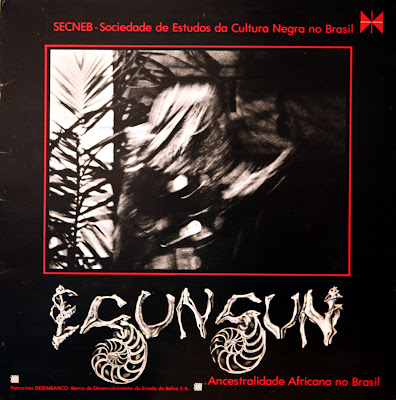
EGUNGUN (Brazil 1964)


This post is an answer of an previous post about Dahomey's Egungun music. This LP is taken from a fantastic work about Egungun ceremonies in Salvador de Bahia. Recorded in 1964, nothing changed between Benin and Brazil.

oro

"Only the spirits that are specially prepared to be invoked and to materialize can receive the name of Egungun, Baba Egun. The main objective of the cult is to make visible the spirits of the ancestors which act as a link between the living and their forefathers. Thus, the Baba bring to their descenders and believers, their blessings and advice but can not be touched. The Egun must always remain seperated from the living."

Side A:
1. Iba Orisha Iba Onile
Salutation to Onile at the beginning of every ceremony.

2. Osanyin
Three chants praising Osanyin, patron of leaves and medecine.

3. Egunugun Kigbale
Through this chant the ancestors are called to come and embody themselves in the world of the living.

4. Ewo Nile
Warning call, something is going to happen. The ancestor is going to arrive.

5. Oro Abi Oro
This chant expresses the meaning of the rit itself oro), re-enacting the comunity links, bringing happiness, goodness and welfare.

6. Onile Mo Bodo Ile
Baba is arriving, he announces himself saluting the elders and asking permission to come in.

7. Nile Wa Alagbe
Baba sings, encouraging the Alagbe, the ritual musicians.

8. Agboula Ago Nile
When Agboula comes to world, evrything rejoices in happiness

9. O She Wara Wara
Two chants in homage to Shango, divine ancestor of the royal dinasty of Oyo from where the Agboula community traces its origins. Many of the Egun revered today, were in life, Shango worshipers.

Side B:
1. Salutations to Baba Olukutun, head of all the ancestors.

2. Loni Ojo Odun
Two chants of great joy for the annual festival of Baba Olukotum. A burst of rockest intensifies the ceremony.

3. Kiye KiyeBo Iroko
Homage to the Egun of the forefathers that were in lifetime woreshipers.

4. Orisha Wa Iye
A chant calling the entities to come and dance with joy.

5. Afulele Ade
A chant in homage to Oya Igbale, queen and patroness of the Egun.

6.Omi Ro
A most profound chnat that evokes all african ancestry.

7. Aluja
The drums play the Aluja, the favourite rhythm and dance for Shango, head of kings, Alafin of Oyo, owner and patron of fire and thunder.